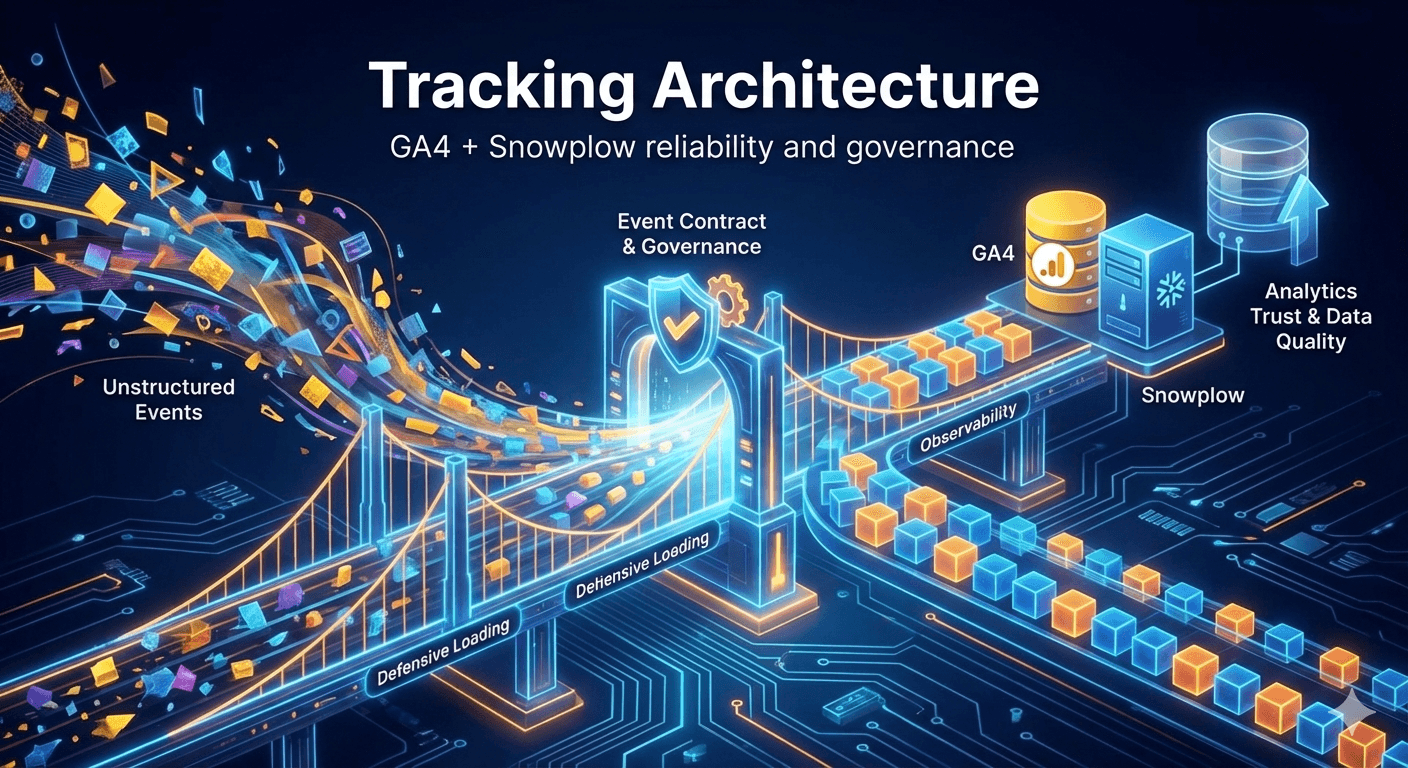
Reliable Web Tracking Architecture (GA4 + Snowplow)#
TL;DR: I improved tracking reliability and analytics quality by standardizing event contracts, reducing silent failures, and making debugging faster—without sacrificing performance.
Context#
When tracking is brittle, teams lose trust in metrics. At scale, you need two things:
- Consistency: a clear event contract that doesn’t drift
- Reliability: systems that detect failures and recover safely
The problem#
- Taxonomy drift: inconsistent event names and payloads across teams.
- Silent data loss: script load failures or blocked requests caused missing events.
- Slow debugging: unclear “what fired, why, and where it failed.”
- Performance tension: more tracking often means slower pages unless engineered well.
What I did#
1) Defined a canonical event contract#
I introduced standard naming + payload expectations:
- canonical event schema (with required fields + versions)
- mapping layer from UI interaction → canonical event
- documentation + examples to keep adoption consistent
2) Improved reliability#
I implemented defensive patterns where appropriate:
- resilient script loading patterns
- graceful fallback behavior (only when safe)
- retries or buffering patterns (if your architecture supports it)
3) Made failures visible with observability#
I added monitoring so failures were measurable:
- dashboards for event volume anomalies
- monitors for enrich/validation failures
- query-based checks (BigQuery / pipeline tables, as applicable)
Outcomes#
Replace placeholders with your real numbers.
- Reliability: reduced drop rate by __%
- Trust: fewer analytics incidents and faster investigations
- Speed: improved tracking quality without regressing key performance metrics
My role#
Architecture + rollout lead:
- event contract design and governance
- implementation and tooling
- cross-team alignment (engineering, product, analytics)
Tech stack#
- Next.js, React, TypeScript
- GA4, Snowplow, GTM (as applicable)
- BigQuery for validation queries
- Datadog (or equivalent) for monitoring
Proof / artifacts#
- event taxonomy + schema documentation
- example validation queries
- dashboard screenshots (failure modes + health metrics)
Next#
Analytics is a product. Reliability + governance is what makes metrics actionable.