
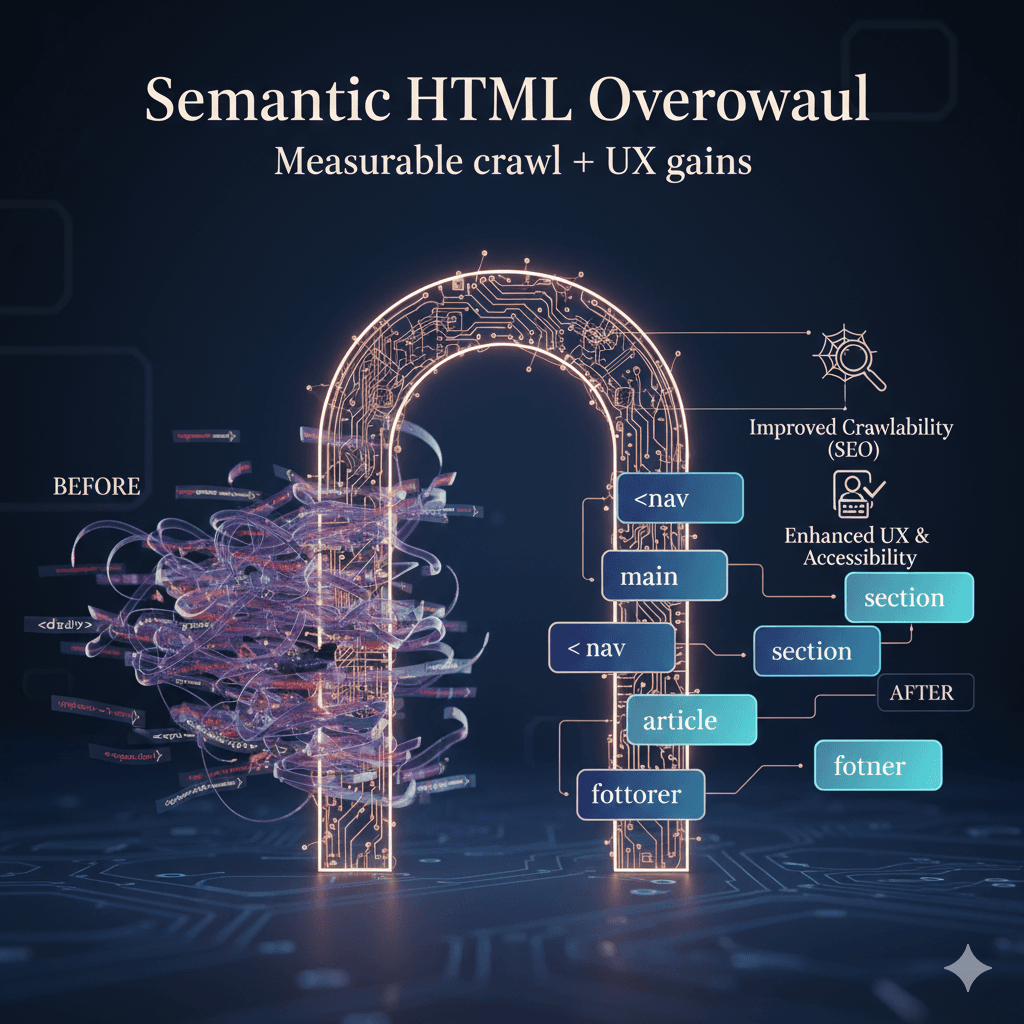
Semantic HTML Patterns that Improved Crawlability and UX#
TL;DR: I led a semantic overhaul across page templates to improve structure, accessibility signals, and server-rendered content clarity—benefiting both users and crawlers.
Context#
In competitive search environments, HTML decisions compound over millions of pageviews: heading hierarchy, landmarks, internal linking, and content structure directly affect comprehension and crawl efficiency.
The problem#
- Inconsistent heading hierarchy created weak information scent.
- Landmarks were missing or misused, hurting accessibility navigation.
- Critical content wasn’t always reliably SSR’d, increasing crawl variance.
- Component patterns encouraged “div soup.”
What I did#
1) Enforced a stable document structure#
I introduced template rules and refactors that made structure consistent:
- One clear
h1per page - Logical
h2/h3sections that match user intent - Proper landmarks:
header,nav,main,section,article,aside,footer
2) Built reusable semantic patterns#
I created component patterns that encode meaning:
- “Entity summary” blocks as
article/sectionunits - FAQ blocks with correct semantics and linking
- Breadcrumb + navigational sections that support journey flows
3) Improved SSR stability for key content#
I reduced “bailouts to CSR” for important page content by:
- making render paths predictable
- ensuring primary content is present server-side
- reducing client-only conditional rendering for critical text
Outcomes#
Replace placeholders with your real numbers.
- Crawl / indexing: improved __ (coverage, rendering consistency, crawl efficiency)
- UX: clearer reading structure + easier navigation
- Accessibility: improved landmark navigation and heading semantics
- Engineering: easier template maintenance and safer component reuse
My role#
End-to-end ownership:
- auditing templates and defining semantic standards
- implementing patterns and reviewing adoption
- coordinating rollout with SEO, design, and product
Tech stack#
- Next.js, React, TypeScript
- Lighthouse / Web Vitals monitoring (as applicable)
- Search Console insights (as applicable)
Proof / artifacts#
- Before/after DOM screenshots (landmarks + headings)
- Lighthouse accessibility deltas
- Internal “Semantic HTML playbook” doc
Next#
Semantic HTML isn’t “nice to have”—it’s a measurable systems upgrade for crawl + UX.